Going into the Honest Trailer for The Mandalorian and Grogu, I realized I didn't know anything about the movie because its promotion was kind of lackluster and after it opened, no one talked about it at all. Oh yeah, it made money, because that's what Disney does, but it performed more poorly than any Star Wars movie since Disney bought the franchise. Critics were "meh, it's okay." Screen Junkies is here to show us why.
Today I found out this movie continues the Disney habit of resurrecting favorite characters, in this case dead aliens, by putting new characters in the old CGI suits, first with Grogu and now with Jabba the Hutt, whose offspring are both heroes and villains. Also, Grogu learns to speak English, a skill that Yoda never mastered. And, of course, there's a lot of killing with no blood. The Mandalorian and Grogu is now available for digital download, and goes on sale on home media August 25th.

As early as the first century BC, industrial workers in China's Sichuan Province were building derricks for wells, but they weren't drilling for oil. While most of the world got salt from ocean water or mines, Sichuan has salty aquifers underneath, and they built wells to bring this brine to the surface. They developed percussion drilling, which harnesses gravity power and patience, but will eventually reward you with salty water. And natural gas.
It took hundreds of years to perfect the technology, but by 1835, they had drilled a well more than a kilometer deep near the town of Zigong. They also developed a method to harness the natural gas released, piping it to factories and using it to power the boilers that extracted salt from the brine. Pictures of the tall derricks of Zigong inspired American George Bissell to drill for oil in the United States in the 19th century. Read about the ancient salt wells of Zigong at Amusing Planet.
(Image credit: Phreakster 1998)
 p
p
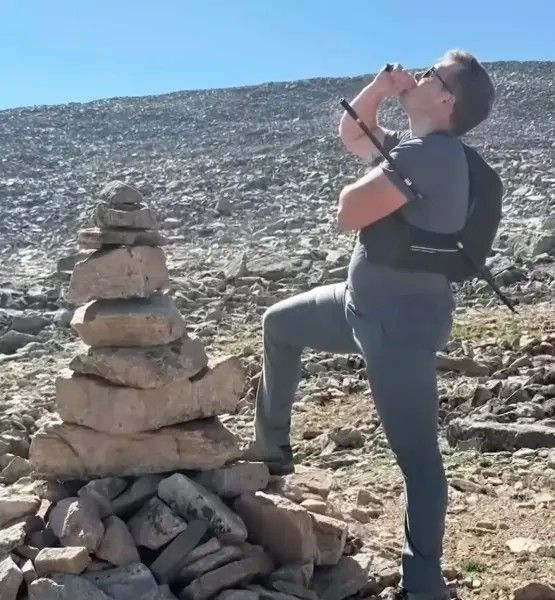
Let us praise David Cifaldi, a 32-year old nurse who was hiking up Granite Peak--the tallest peak in Montana. KTMF 12 News reports that Cifaldi was about 10 miles into the hike, he was accidentally impaled with a hiking pole.
As a medical professional, he was able to make a rational judgment about how to proceed. Would he be able to return under his own power? Cifaldi decided that he could. So, escorted by his friends, he hiked 10 miles over 6 and 1/2 hours to return to the trailhead and be driven to a hospital.
YouTuber Limba Trip is creative maker of things, mostly hand-made zoetropes, anamorphic images, and music. One of his zoetropes that has gone viral shows ants dancing on a plate.
In this time-lapse video, Limba Trip draws each ant carefully by hand. When the plate is spun, the animated effect is mesmerizing.
-via The Awesomer
In the wild, many gray squirrels die in infancy, and those who survive can live to about six years on average. Thumbelina almost died in infancy. She was only a couple of hours old when her nest was destroyed, but this family took her in. That was ten years ago. Thumbelina is well adjusted to being an indoor squirrel, but she's got some problems in her old age. She developed polycystic ovarian syndrome, which causes her to gain weight easily, and left her quite round. She has also lost teeth, which means her family has to not only strictly measure her food, but puree it as well.
How much effort is too much for a pet squirrel? Thumbelina's family doesn't seem to mind at all, even though they've gone to extraordinary lengths for her. She's got quite a personality and brings them joy. You can see more of Thumbelina at Instagram.

I learned to drive on a 1970 Volkswagen Microbus. It had a gear shift that seemed three feet long. It wasn't powerful and didn't go fast, especially uphill, and it was never warm enough. As soon as I had my license, I was recruited to drive high school band members or the drama club to faraway events. Party time!
These Microbuses are pretty rare these days, and the vehicle shown here isn't really a Volkswagen anymore. It's a Kindred EV Bus. Yes, all electric. The company Kindred buys up vintage microbuses and restores them with Corvette suspensions, automatic transmissions, and 300 horsepower Cascadia electric motors. Jason Torchinsky takes us through all that work and explains how the Kindred EV Bus has the look and feel of nostalgia with the performance of a high-end modern electric vehicle. Too bad it costs a quarter-million dollars. Read all about the electric Frankenbus at the Autopian.
Fast food restaurants in the US gather together around interstate exits, and they offer variations on sandwiches, chicken pieces, pizza, burritos, and fried potatoes on the side. They taste the same from coast to coast. Then in late summer, state and county fairs go wild and offer expensive opportunities to combine wildly disparate foods just for the fun of it- then they go away.
Those brands expanded to other countries where food cultures vary from the American model. You can't tell people in Italy that only American cheese is available, and you can't tell people in Thailand that chocolate doesn't belong on a hamburger. And fast food outlets have to give customers what they want. You know, I could get on board with an edible coffee cup if it weren't for all the people who touched it before me.
Tom Blank, the original voice of Weird History, takes us on a tour of international fast food offerings that might gross you out, but might also make you want to travel to try them.
July 23, 2026, was the busiest day for commercial air travel ever, according to data from @flightradar24.
— Colin McCarthy (@US_Stormwatch) July 25, 2026
A whopping 153,359 commercial flights were tracked worldwide. pic.twitter.com/0fJ9mcjZkY
With the instability of international oil markets due to the war in the Persian Gulf and what the International Air Travel Association (IATA) describes as decreased customer demand, one might expect that commercial air travel would be limited. But people nonetheless flew in record numbers, breaking a previous record set in 2023 by 14,122 flights.
These figures, of course, do not include non-commercial air travel, such as military flights.
-via John Konrad
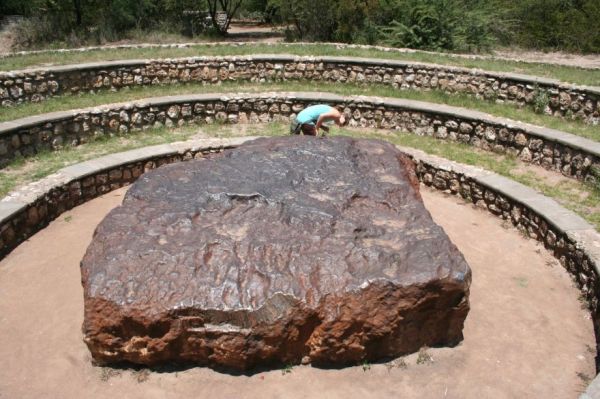
Some 80,000 years ago, a huge iron and nickel meteor landed on earth in what would eventually become the Hoba West farm near Grootfontein in Namibia. In 1920, a farmer ran into the big hunk of metal while plowing, and scientists have been studying the Hoba meteorite ever since. How did such a large meteorite survive and not leave a huge crater?
There are several reasons. One is the meteorite's shape, which is assumed to be a remnant of a much more massive meteor. It is a slab, and had to have arrived at a shallow angle, greatly slowed down by our atmosphere. You can almost imagine it coming in like a rock skipping across a lake. Its internal structure also plays a part. And 80,000 years later, it sits in the same spot where it landed because it weighs 60 metric tons, even after chunks have been taken over the past 100 years. Excavations have determined that Hoba actually had a crater once, although a strangely shallow one, which was filled in naturally over many centuries. Read about the massive Hoba meteorite and its weird history at ZME Science. -via Damn Interesting
(Image credit: Compl33t)
Magnificent music mixer Bill McClintock is at it again, with another unlikely rock/soul mashup. Eddie Kendricks never rocked so hard! This one features vocals from The Temptations's 1966 hit "Get Ready" and the music from "Lack of Communication" by Ratt from 1984. Despite being written and produced by Smokey Robinson, the Temptations' song did not do as well as was expected, and the remake by Rare Earth in 1970 was a bigger hit. Still, the Temptations version of "Get Ready" proved to be long lasting, and familiar even 60 years later. The Ratt song? Well, maybe you had to be a metalhead at the time to really know the song, but it has the distinctive sound of Ratt.
And if you are such a metalhead, you might recognize Dimebag Darrell's guitar work from the 1994 Pantera song "I'm Broken" in this mix as well. Enjoy songs song three different decades in this masterful mashup.
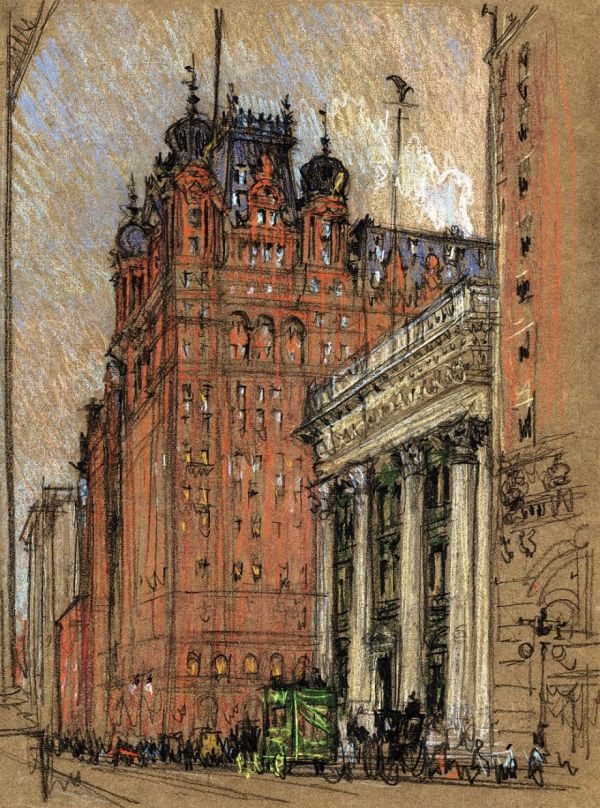
New York City's Waldorf Astoria Hotel was once two hotels, the Waldorf and the Astoria. Both were considered the height of luxury in their day, with electric lights and a bathroom for every suite. The Waldorf Hotel opened in 1893, with the Astoria following in 1897. Before the hotels went up, those sites held two mansions belonging to heirs of John Jacob Astor, New York's first multimillionaire. On one side was Astor's great-grandson, William Waldorf Astor, and the other was his aunt Caroline Astor. The two mansions were separated by a garden.
William moved to England, and had the Waldorf Hotel built in order to ruin the view for his aunt Caroline. Caroline's son, John Jacob "Jack" Astor IV, built the Astoria Hotel next door in revenge. It was many years later when these competing branches of the family made up and combined the two hotels into New York's premiere inn. But what caused the feud between William and Caroline? You'd be surprised at how petty it was, and you can read that story at Ephemeral New York. -via Strange Company
(Image credit: Joseph Pennell)
In this music video, musician Barry Bergen travels to Africa in the 1980s to glean the ancient wisdom of this magical land. Mr Jambo is an older man who must have the enlightenment Bergen is looking for, but he doesn't speak English. Indeed, the closed captions tell us that he is saying, "I don't speak English. Do you have a translator?" Meanwhile, Bergan mentions jambalaya and bears, as if they have anything to do with Africa. As silly as the premise is, the song is quite catchy.
There is no Barry Bergen; he's a creation of comedian Kyle Gordon who has has made a career of parodying songs from genres you may not be consciously aware of, but you'll recognize when you hear them. The song "Mr. Jambo" is a parody of the "white guy goes to Africa" genre that you know mostly from Paul Simon's album Graceland, although it's been done by others. "Mr. Jambo" is from Gordon's third album Kyle Gordon Is Everywhere, to be released in October. -via Boing Boing

I San Diego this weekend? Whether you're a resident or just in town for SDCC, be sure to stop by the Paramount+ Lodge to live out your Star Trek dreams. Because who hasn't wanted to sip on a Vulcan sunset (sadly Romulan ale was unavailable) while enjoying music spun by an Andorean DJ?
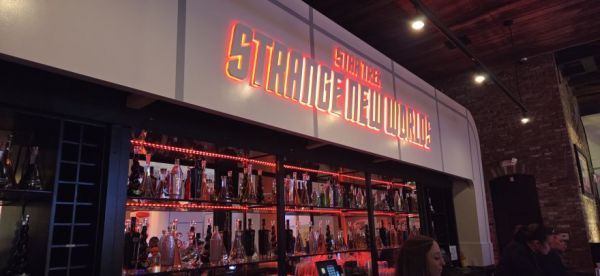
You could even leave via transporter and head down to an alien planet.

It's not too early to start preparing for the harsh winter weather coming. This all-terrain vehicle in Hudson, New Hampshire available on Facebook Marketplace is ideal. It's a 1996 Mitsubishi Bravo, which is normally a city vehicle designed for quality roads.
You may have noticed some modifications to the original design. It has tracks from a Polaris UTV instead of wheels to provide for traction on snow. Although it's on sale for $11,500, the owner is willing to trade it for an ATV and cash.
-via Jalopnik
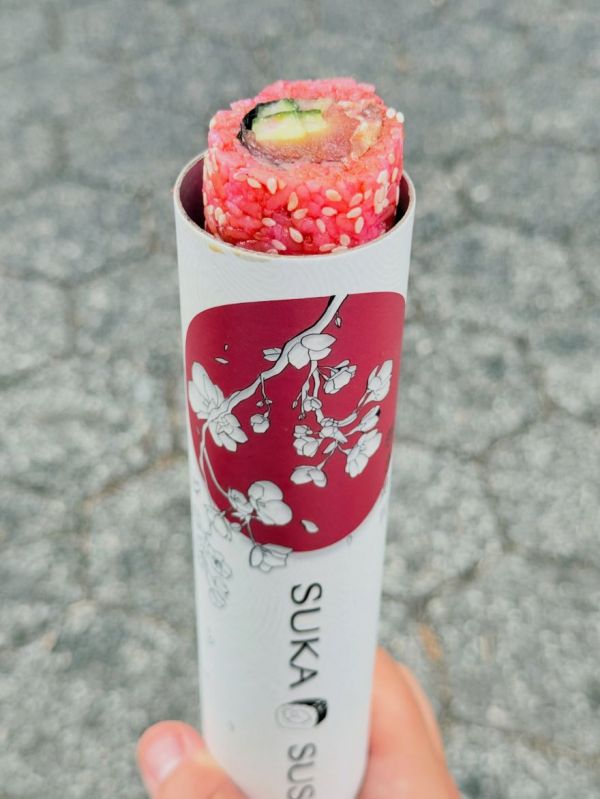
Suka Sushi in New York City is pioneering a revolutionary new sushi delivery mechanism. It's a push pop! The chefs at this counter service sushi restaurant put high-grade sushi inside. To eat, just push from the bottom, like the classic frozen treat.
There's a lot of merit to this design. If you're on the go, sushi can be hard to eat. Just push the bottom of the cardboard tube to expose another segment of sushi.
Food & Wine magazine offers a positive review, although each tube is pricey at $15-17. Think of the extra cost as a convenience fee.
-via Massimo | Photo: natenibblez